

20 Apr Unwind Direction Explained: A Beginner-Friendly Guide to Roll Labels
If you’re new to roll labels, “unwind direction” is one of those terms that sounds more complicated than it actually is.
But here’s the catch:
If you get it wrong, your labels may apply upside down, sideways, or in the wrong position entirely.
So, let’s break it down in a way that actually sticks (yes… pun intended!).
Before we do that, though, let’s talk a bit about what roll labels actually are.
What Are Roll Labels? (And When Are They Used?)
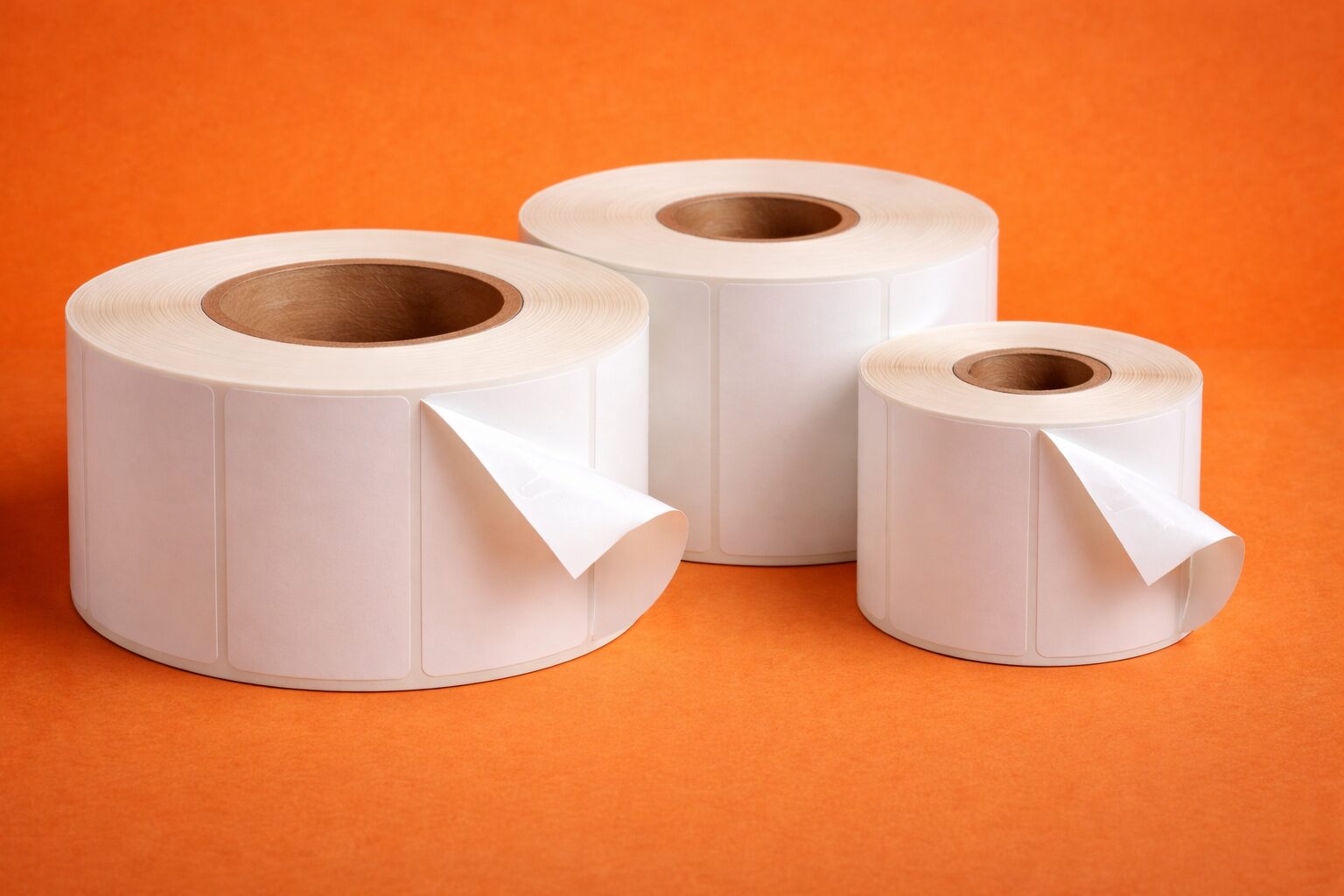
Roll labels are labels supplied on a continuous roll, rather than as individual sheets or stacks.
They are designed to be:
- Applied by machine (automatic or semi-automatic applicators)
- Printed in-house using thermal or inkjet label printers, or
- Printed by your label printing partner and applied in-house by you
- Used efficiently in higher-volume workflows
Whether your labels are standard stocked sizes, or custom size labels, getting unwind direction right is critical.
How Roll Labels Differ from Other Label Types
Think of label formats like this:
- Roll labels → Built for speed and consistency
- Sheet labels → Better for small batches or office printers
- Fan-fold labels → Used in some industrial or continuous printing setups
If you’re using a label applicator or a dedicated label printer, you’re almost always using roll labels.
When Roll Labels Are the Right Choice
Roll labels are typically used when:
- You’re labeling products in medium to high volumes
- You’re using a labeling machine or applicator (learn more about making the switch to in-house printing here)
- You need consistent placement and alignment
- You want to streamline production and reduce manual handling
Common applications include:
- Food and beverage packaging
- Personal care products
- Industrial and chemical containers
- Shipping and logistics
Unwind direction is something that’s critical no matter what your label material and adhesive choice is. If you’re not quite sure what label adhesive will work best for you—don’t worry, we’ve got you covered with separate articles on that topic, too.
Why This Matters for Unwind Direction
Unwind direction only applies to roll labels—because it describes how the roll feeds through a printer or applicator.
No roll = no unwind direction.
So if you’re working with roll labels, understanding unwind direction is part of getting your labels to apply correctly every time.
What Is Unwind Direction?
Unwind direction refers to how labels come off a roll as it feeds through a printer or applicator.
Think of it like this:
Imagine a roll of paper towels.
Depending on how you hold the roll, the sheet can come off:
- Over the top
- From underneath
- Rotated sideways
Labels work the same way—but machines care a lot more than paper towels do. More info on printer compatibility here.
Why Unwind Direction Matters
If you’re applying labels by machine, unwind direction is critical.
It determines:
- How the label feeds into the applicator
- The orientation of the label when applied
- Whether your label lands correctly on your product
If the unwind direction is wrong:
- Labels can be upside down
- Text can be rotated 90° or 180°
- Labels can apply off-centre
The 8 Standard Unwind Directions
There are 8 standard unwind directions used across the label industry.
They’re typically described using two variables:
- Edge leading (Top / Bottom / Left / Right)
- Winding orientation (Outside vs inside)
You’ll often hear them described like:
- Top Off
- Bottom Off
- Right Off
- Left Off
Each one simply describes which edge of the label comes off the roll first.

Think of It Like This
Here’s the simplest way to visualize it:
The “leading edge” is the part of the label that hits your product first.
So:
- Top Off = top of the label hits first
- Bottom Off = bottom hits first
- Right Off = right side hits first
- Left Off = left side hits first
If your label has text or a logo, this determines whether it lands:
- Upright
- Rotated
- Completely upside down
Machine Application vs Hand Application
If You’re Using an Applicator (Machine)
Unwind direction is non-negotiable.
Your machine is designed for a specific feed direction.
If the roll doesn’t match it, the system can’t compensate.
This is why your supplier will ask for:
- Machine make and model
- Application method (wipe, tamp, wrap, etc.)
If you’re not sure, or just want to confirm, you can check your machine’s manual, or send the specific model to us, and a Summit Label Specialist will ensure you go with the correct option.
If You’re Applying Labels by Hand
Unwind direction matters much less.
You can rotate the roll or adjust as needed.
That said:
- Consistency still helps
- It makes application faster and more intuitive
- It prevents confusion when scaling later
How to Determine the Right Unwind Direction
Here’s the practical version:
Step 1: Look at Your Machine
Your applicator defines the requirement—not the label.
Step 2: Identify the Leading Edge
Which part of the label needs to hit the product first?
Step 3: Match Orientation
Make sure the label is upright at the moment it contacts the product
Common Real-World Scenarios
Bottle Labeling (Wrap Applications)
Typically:
- Labels feed horizontally
- Orientation must match wrap direction
Often uses Right Off or Left Off.
Top Labeling (Boxes, Containers)
- Label is applied from above
Typically Top Off.
Front Panel Product Labels
- Applied vertically to bottles or containers
Depends on machine setup, but often Top Off or Bottom Off.
The Most Common Mistake
People assume unwind direction is about how the roll looks.
It’s not.
It’s about how the label is oriented at the exact moment it’s applied.
That distinction alone saves a lot of headaches.
Pro Tip: Always Confirm Before Ordering
Even experienced teams double-check unwind direction—because:
- Machines vary
- Setups change
- Small differences matter
A quick confirmation upfront prevents reprints, delays, and wasted inventory. If you want to double check you’re ordering the right unwind direction before you place your order, reach out to us here—we’re more than happy to confirm for you!
Summary (The “If You Remember One Thing” Version)
Unwind direction is simply:
Which edge of your label comes off the roll first—and how it’s oriented when applied.
Get that part right, and everything else falls into place.
Unwind Direction vs Core Orientation (Quick Clarification)

Unwind direction is often confused with core size and roll orientation—these are separate specs that all work together to ensure compatibility with your equipment.
Not Sure What You Need?
This is one of the most common questions in label printing—and one of the easiest to get right with a quick check.
Even experienced production teams confirm unwind direction before placing an order—because a small orientation mistake can lead to expensive reprints. If you’re unsure:
Hickman’s team can help confirm the correct unwind direction before production, just get in touch with us here.
Send us:
- your printer or applicator model
- how the label is being applied
- and whether labels are applied by hand or machine
Our team can help confirm the correct unwind direction before production.
Updated April 2026.