

29 Jan Blank vs. Printed Roll Labels: How to Decide When to Print In-House From Hickman Experts
As labeling needs evolve, many businesses reach the same crossroads:
Should we continue ordering printed roll labels, or is it time to print labels in-house using blank roll labels and our own printer?
There’s no one-size-fits-all answer — and the right choice often changes as your operation grows. Understanding the tradeoffs between printed labels and in-house printing can help you choose the option that best supports your workflow, budget, and long-term goals.
This guide breaks down how each approach works, when each makes the most sense, and how many businesses transition between the two over time.
What Are Printed Roll Labels?
Printed roll labels arrive fully finished with your artwork already applied. They’re produced using professional printing equipment and are ready to apply as soon as they arrive.
Printed labels are commonly used when:
- Branding consistency is critical
- Volumes are stable and predictable
- Specialty finishes or exact color matching are required
- Labels will be applied at scale
Because printing is handled externally, printed labels eliminate the need to manage printers, inks, maintenance, or color calibration in-house. More details on in-house label printing here.
What Are Blank Roll Labels and In-House Printing?
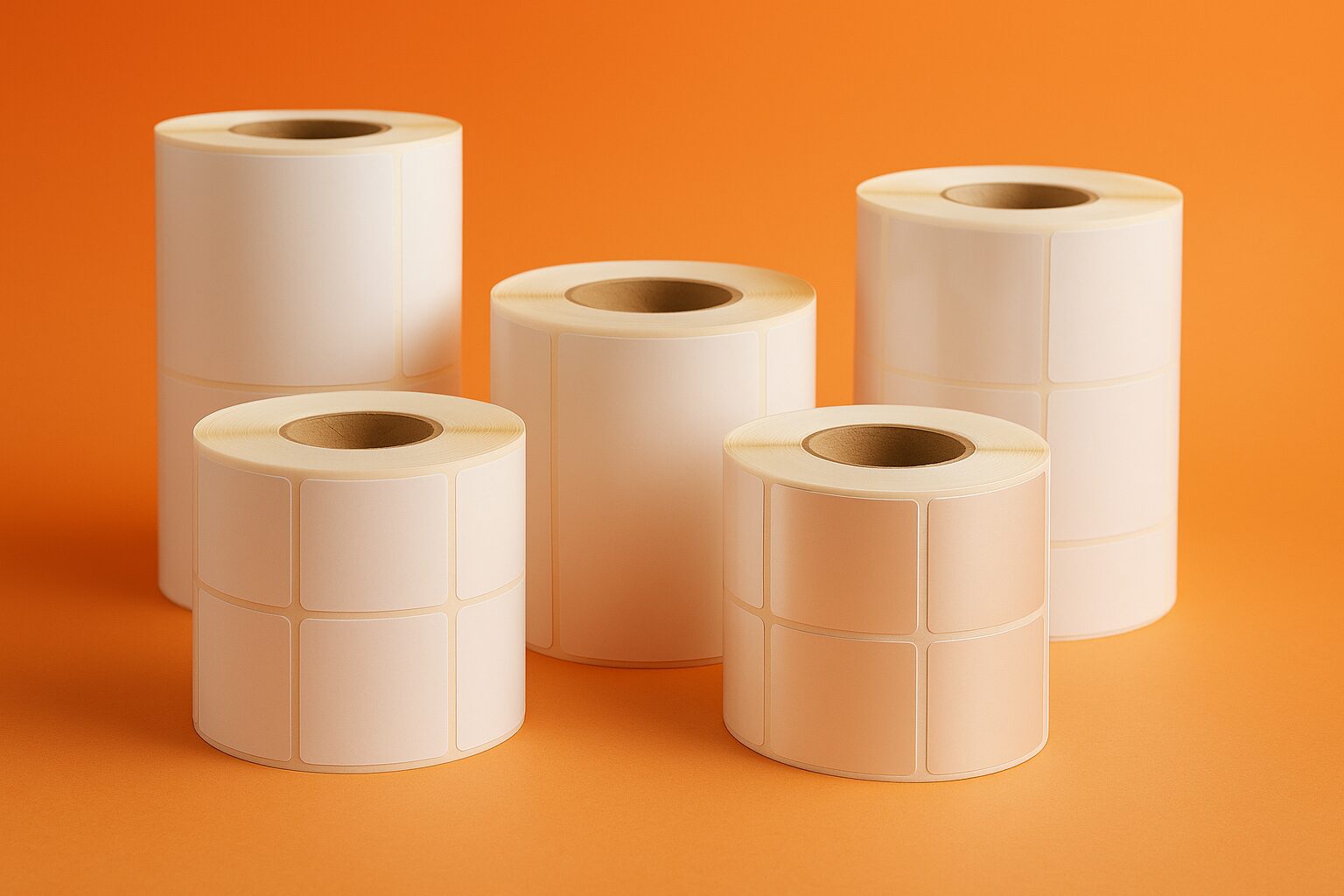
Blank roll labels are unprinted labels supplied on rolls, designed to be printed using inkjet, laser, or thermal printers on-site.
This approach gives teams direct control over printing and is especially useful when:
- Label designs change frequently
- Variable data (barcodes, lot numbers, dates) is required
- Short runs are common
- Speed and flexibility matter more than finishes
In-house printing allows labels to be produced on demand, reducing the need to forecast quantities far in advance. As long as you have all the details correct for your blank roll labels order, like unwind direction and adhesive selection, in-house printing can be a very efficient solution.
Key Factors to Consider When Choosing Between Printed and In-House Labels
- Volume and Run Size
Volume is often the first tipping point.
- Low to moderate volumes: In-house printing can be efficient and flexible.
- Higher volumes: Printed labels often provide a lower cost per label once scale is reached.
As volumes increase, outsourcing printing can reduce labor and equipment strain.
- Design Stability
How often do your labels change?
- Frequent changes (ingredients, compliance updates, seasonal branding): In-house printing shines, even with custom size or die-cut labels.
- Stable, long-term designs: Printed labels are usually more efficient and consistent.
Many businesses use in-house printing early on, then shift to printed labels once designs stabilize.
- Color Accuracy and Finish Requirements
Printed labels offer access to finishes and print consistency that most desktop printers can’t replicate.
Printed labels are ideal when you need:
- Precise brand color matching
- Gloss, matte, or laminated finishes
- Specialty effects like spot varnish or metallic inks
In-house printing prioritizes flexibility over finish complexity.
- Operational Workflow
Think about where labeling fits into your daily operations.
In-house printing:
- Requires printer setup and maintenance
- Adds printing as an internal task
- Works well when labeling happens close to fulfillment
Printed labels:
- Remove printing from your internal workflow
- Reduce equipment management
- Support automated or high-speed application lines
There’s no wrong answer — just different operational tradeoffs. We’ve made a comprehensive library of printers we supply labels for—find that here.
- Cost Beyond the Label
It’s easy to compare only per-label pricing, but the full cost picture includes:
- Printer purchase and upkeep
- Ink or toner consumption
- Labor time
- Waste from misprints or test runs
Printed labels bundle these variables into a predictable cost structure, while in-house printing trades predictability for flexibility.
When Businesses Often Transition Between the Two
Many companies don’t choose one approach forever — they evolve.
A common progression looks like this:
- Start with in-house printing for flexibility and small runs
- Shift core SKUs to printed labels as volumes grow
- Continue using in-house printing for variable or short-run needs
This hybrid approach allows businesses to get the best of both worlds.
How Hickman Supports Both Approaches
Hickman supports customers at every stage — whether you’re ordering printed roll labels, printing in-house, or doing both.
Our team helps:
- Match label materials to printers and applications
- Select adhesives based on real-world conditions
- Identify when it makes sense to transition from one approach to another
- Avoid common issues like poor adhesion, feeding problems, or premature label failure
The goal isn’t to push one option — it’s to make sure your labels work as intended.
So… Which Option Is Right for You?
Choose printed labels if you need:
- Consistent branding at scale
- Professional finishes
- Minimal internal print management
Choose in-house printing if you need:
- Flexibility and fast changes
- Variable data printing
- Control over timing and quantities
And if you’re unsure? That’s normal. Many businesses use both at different stages.
Talking through your application, volumes, and workflow with a label specialist can clarify the best path forward — and save time and cost down the line. So, let’s chat!
Updated January 2026.