

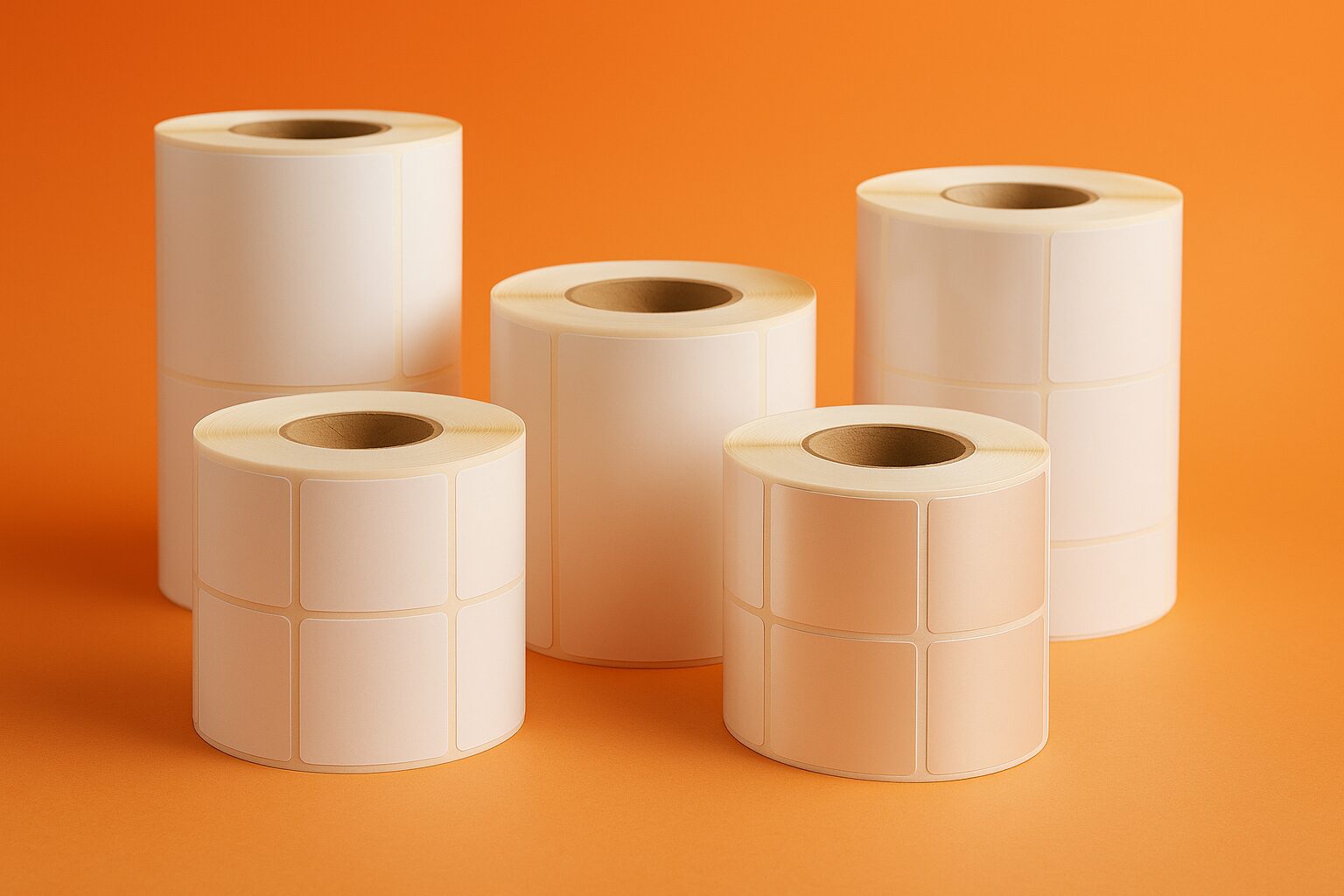
12 May Custom Size Roll Labels: Die-Cut vs Continuous Rolls and How to Choose the Right Format
If you’re ordering roll labels, one of the first questions is usually:
“Can I get the exact size I need?”
Short answer:
Usually, yes.
But the better question is:
“What size and format will actually work best for my product and printer?”
Because custom size roll labels involve more than just width and height.
You also need to consider:
- die-cut vs continuous rolls
- printer compatibility
- core size
- unwind direction
- timing marks
- whether custom tooling is required
Getting those details right upfront prevents production delays, wasted labels, and expensive reorders later.
Let’s break it down.
What Does “Custom Size Roll Labels” Actually Mean?
Custom size roll labels are labels made to your specific dimensions rather than choosing from a standard stock size.
That can include:
- custom width
- custom height
- custom shape
- roll diameter
- core size
- unwind direction
- spacing between labels
Many people assume “custom size” just means changing the width.
In reality, your printer and application method often determine what’s actually possible.
The goal is not simply getting the exact size you want.
It’s getting the right size that works with your equipment and application so you don’t inadvertently cause yourself downstream headaches.
Die-Cut Labels vs Continuous Roll Labels
This is one of the most important decisions.
Die-Cut Roll Labels
Die-cut labels are pre-separated labels with a defined shape and gap between each label.
These are the labels most people picture when they think of product packaging.
Common uses:
- retail packaging
- product branding
- food and beverage labels
- cosmetic packaging
- compliance labels
Best for:
fixed-size labels with consistent placement
Advantages:
- clean, professional presentation
- easier automated application
- consistent spacing and alignment
- strong compatibility with most label applicators
These are ideal when every label needs to look exactly the same.
Continuous Roll Labels
Continuous labels are supplied as one uninterrupted roll without pre-cut separation.
The printer determines where each label starts and ends.
Common uses:
- shipping labels
- barcode labels
- warehouse operations
- variable-length product labels
Best for:
labels where content or size changes frequently
Advantages:
- flexible label length
- efficient for variable data printing
- no need for a specific die size
Continuous labels are often the better choice when speed and flexibility matter more than presentation.
How Your Printer Affects Label Size
This is where many people get surprised.
The biggest limitation is often not the label—it’s the printer.
Your printer may require specific:
- maximum roll width
- minimum roll width
- core size (1″, 3″, etc.)
- maximum outer diameter
- unwind direction
- black timing marks
- sensor-compatible spacing
Note: Hickman regularly produces small labels with extra-wide margins to fit 2’ minimums.
For example:
A printer may technically support a 4” wide label—but not if the roll diameter is too large for the machine.
This is why printer model matters before label specs.
Not after.
Hickman’s blank roll label builder already asks for many of these details because compatibility matters.
When Custom Sizes Require New Tooling
Not every custom size requires new tooling—but many custom shapes do.
Standard Sizes
If your size matches an existing die, setup is faster and more cost-effective.
This is often the best option for:
- rectangles
- squares
- circles
- common ovals
Custom Die-Cut Shapes
If you need:
- unique dimensions
- specialty shapes
- unusual corner radius
- custom contours
…a new flex tool or die may be required.
This affects:
- setup time
- minimum order quantities
- overall cost
This is why some custom orders require a higher minimum than standard blank roll labels.
Cool shapes are great.
Custom tooling is how reality invoices you for them.
Common Ordering Mistakes
These are the issues that cause the most avoidable headaches.
Mistake #1: Ordering by Finished Size Only
Customers often provide only:
“I need a 3” x 4” label”
But that doesn’t include:
- printer requirements
- unwind direction
- core size
- spacing
- timing mark requirements
The finished label size is only part of the spec.
Mistake #2: Assuming Continuous Is Always Cheaper
Continuous rolls can reduce tooling costs—but they are not automatically the better choice.
If precise presentation matters, die-cut labels are often the better long-term solution.
Cheaper upfront is not always cheaper operationally.
Mistake #3: Ignoring Printer Requirements
This one creates the most expensive surprises.
Always confirm:
what your printer can physically run
before ordering labels.
Not after delivery.
That is a deeply frustrating way to learn—take it from us! Happily, a few checks before you order can avoid this entirely.
Quick Decision Guide
Choose Die-Cut Labels When:
- labels are fixed-size
- branding and presentation matter
- automated application is used
- consistent placement is critical
Choose Continuous Labels When:
- label length changes frequently
- variable data is printed
- shipping or barcode workflows are involved
- flexibility matters more than appearance
Not Sure Which Format You Need?
Connect with us here and send us:
- your printer model
- your desired label size
- whether labels are blank or pre-printed
- whether you need die-cut or continuous
- if your printer requires timing marks
Hickman’s team can help confirm the right label format before production.
Because ordering labels shouldn’t feel like solving a mechanical engineering exam.
Even if sometimes it kind of is.
Final Takeaway
Custom size roll labels are not just about dimensions.
They’re about matching:
your product
your printer
your workflow
The best label is not the one that looks right on paper.
It’s the one that works correctly in production.
That’s usually the more expensive lesson to learn the hard way, and now you don’t have to. Happy labelling!
Published May 2026.