

14 Nov Blank vs Pre-Printed Roll Labels: Cost, Turnaround & Use-Case Decision Guide
Whether you’re printing in-house or outsourcing finished rolls, label decisions come down to three core variables: cost, turnaround time, and use case. Each method—blank or pre-printed—offers distinct advantages depending on your volume, design needs, and operational setup.
Here, our production leads break down the trade-offs so you can decide when in-house printing makes sense and when professional pre-printing gives you the better ROI.
What’s the Difference Between Blank and Pre-Printed Roll Labels?
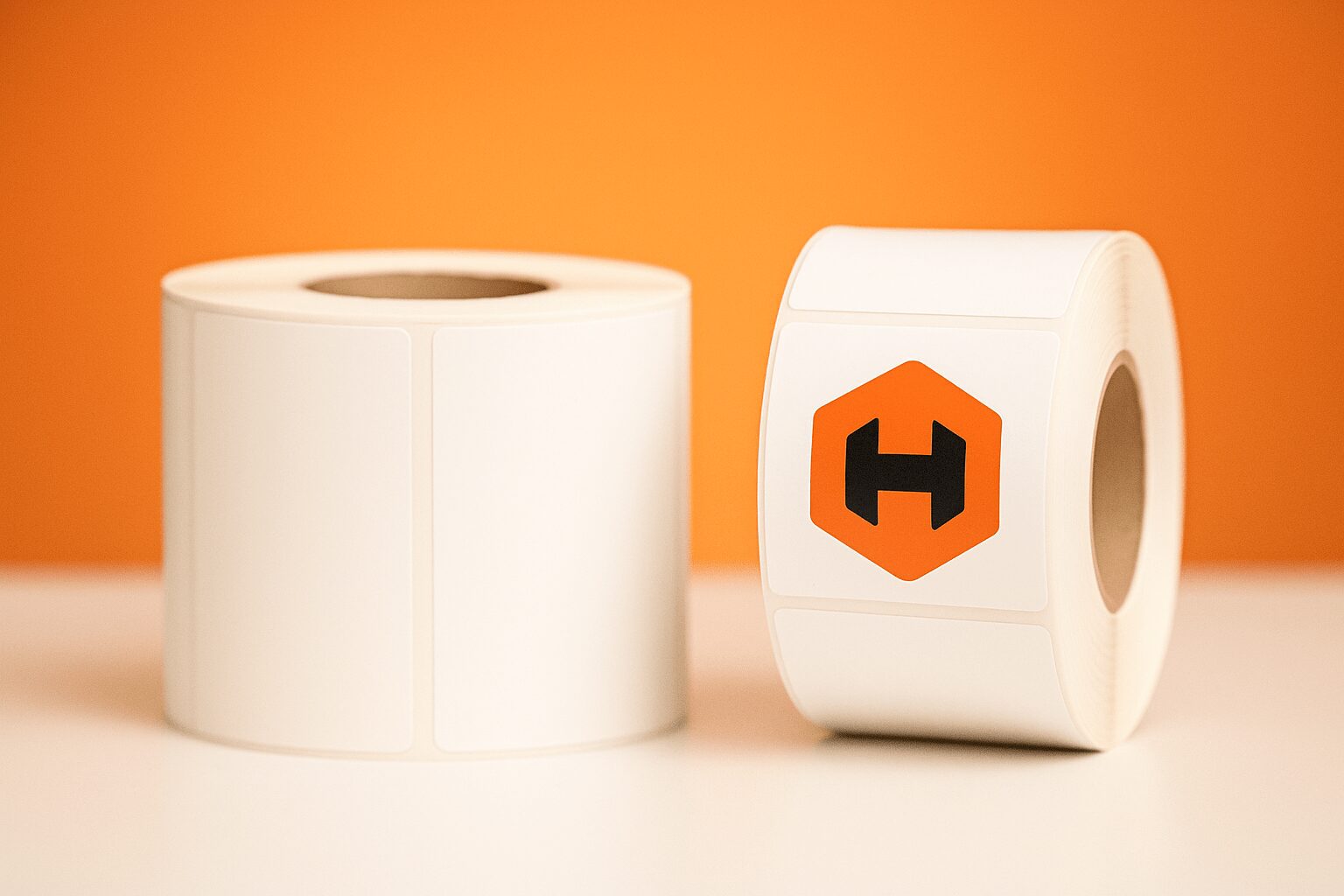
Blank roll labels are unprinted stock materials supplied by companies like Hickman—usually paper or BOPP, die-cut to size, ready for use in your own inkjet, laser, or thermal printer. You control the design, color, and quantity right at your facility.
Pre-printed roll labels, on the other hand, are produced by your label converter (like Hickman) with full-color artwork, embellishments, and finishing. You receive rolls ready to apply with no further printing required.
When to Use Blank Inkjet Roll Labels
Best for: short runs, variable data, and fast-changing SKUs.
Blank roll labels are ideal for businesses that need agility. With digital inkjet printers now offering near-commercial quality, in-house printing has become a legitimate option for small to mid-volume brands.
Advantages
- Immediate turnaround. Print on demand and eliminate wait times for press runs or shipping.
- Low minimums. Perfect for test batches, seasonal releases, or pilot projects.
- Variable printing. Easily change artwork, barcodes, or expiration dates between runs.
- Lower per-run cost at small quantities.
Limitations
- Higher ink cost per label. Inkjet ink and maintenance add up with scale.
- Limited finishes. You’re constrained to matte or gloss coatings; foils, spot varnish, and textures aren’t achievable in-house.
- Color consistency. Without calibrated color management, printed output may vary slightly between batches.
Typical Use Cases
- Craft food and beverage startups
- Boutique cosmetics
- Nutraceutical sample sizes
- Private-label and test-market packaging
- Warehouse and shipping operations
When to Use Pre-Printed Roll Labels
Best for: consistent high-volume runs and premium branding.
When your design is stable and your product volume justifies it, pre-printed rolls deliver superior speed on the application line and unbeatable consistency.
Advantages
- High-speed application. No on-demand printing step; just apply.
- Lower unit cost at scale. Once the setup is complete, bulk printing reduces the cost per label.
- Special finishes. Metallics, spot gloss, embossing, and tactile coatings are only achievable with professional presses.
- Color accuracy. G7 or GMI color standards ensure brand consistency across reorders.
Limitations
- Longer lead times. Production, proofing, and shipping can add time when you might not have it.
- Less flexibility. Changes to design or data require a new run.
- Higher upfront investment. Minimum orders are typically higher to justify setup costs.
Typical Use Cases
- Beverage, wine, and spirits
- Established consumer packaged goods
- Seasonal retail packaging
- Products requiring tactile finishes or metallic inks
- Private-label packaging for distribution
Cost Comparison: Where the Crossover Happens
| Factor | Blank Roll Labels + In-House Printing | Pre-Printed Roll Labels |
|---|---|---|
| Upfront Cost | Lower per order, but requires printer investment | No printer investment required |
| Per-Label Cost | Lower at higher volumes | Often better for smaller consistent runs |
| Ink / Ribbon Costs | Ongoing expense | Included in supplier production |
| Labour Time | Internal staff time required | Minimal internal handling |
| Design Changes | Fast and flexible | Requires reorder |
| Print Consistency | Depends on equipment + operator | Highly consistent |
| Turnaround | Immediate for short runs | Production + shipping time |
In general, the break-even point is around 3,000–5,000 labels per SKU. Below that, blank rolls tend to be more cost-effective and nimble. Above it, pre-printing becomes more efficient.
Each business is unique, though, and if you’d like to run through your specifics with us, get in touch here and we’d be happy to nerd out over label-printing break-even points with you.
A General Rule of Thumb
If your labels are identical and used in high volumes, pre-printed labels are often more cost-effective.
If your labels change frequently or require variable information, blank labels and in-house printing often provide better long-term flexibility.
Turnaround Time & Operational Efficiency
Blank Labels
- Immediate access to new SKUs or corrections.
- Zero dependency on vendor timelines.
- Ideal for businesses that can’t afford downtime due to delayed label shipments.
Pre-Printed Labels
- Time investment is front-loaded in setup, proofing, and press time.
- Once in motion, large runs can ship quickly and be stored for months of use.
- For steady, predictable SKUs, outsourcing frees up labor hours otherwise spent printing in-house.
Typical Decision Framework
Pre-Printed Often Makes More Sense When:
- artwork rarely changes
- high-volume repeat orders are common
- brand consistency is critical
- no in-house printer exists
Blank Labels Often Make More Sense When:
- SKUs change frequently
- variable data is needed (dates, batch codes, barcodes)
- short runs happen often
- fast same-day label changes matter
Environmental and Waste Considerations
Every reprint, delay, or misrun has a carbon cost.
- Blank labels minimize waste for fast-moving SKUs, since you print only what you need.
- Pre-printed labels reduce energy use per label once volume scales, and are compatible with recyclable films and liners.
Common Questions
Are blank roll labels cheaper than pre-printed ones?
Only for small runs. Ink and labor costs rise quickly with scale, so pre-printed rolls become more economical past a few thousand labels.
Can I combine both methods?
Yes — pre-print your static artwork and use your inkjet or thermal printer for variable information. Many brands do exactly that.
What about color matching?
Professional presses are calibrated to color standards. If you print in-house, use ICC profiles and color-management tools for consistent output.
What if I need waterproof labels?
Film materials like BOPP or polyester are available in both blank and pre-printed formats. Your application environment should guide your choice.
The Hidden Costs People Forget
Printing labels in-house might seem like the obvious choice if you’re only considering per-order costs, but there’s more hard costs to consider when you move printing in-house, like:
- printer maintenance
- ink / ribbon replacement
- operator time
- production downtime
- misprints and wasted labels
- rush reorder costs
Don’t fall into the trap of equating “price” to “ROI”—they don’t always play on the same team.
Many Businesses Use Both
Example:
- pre-printed for branded product labels
- blank labels for shipping, barcodes, compliance labels, variable data
Many seasoned ops teams end up with a version of this model—for good reason.
Example:
A food manufacturer may use:
- pre-printed labels for branded retail packaging
- blank labels for batch codes, expiry dates, and shipping labels
So, Should You Print In-House or Order Pre-Printed Labels?
Do you change label content often?
If yes = blank labels may be better
Are you applying large quantities of identical labels?
If yes = pre-printed may be better
Do you need batch codes, expiry dates, or variable info?
If yes = blank + in-house usually wins
Do you want the lowest labour involvement?
If yes = pre-printed often wins
Not Sure Which Approach Makes More Sense?
Get in touch with us here and tell us:
- what product you label
- how often labels change
- your approximate monthly volume
- whether you already print in-house
We’ll help you determine whether blank or pre-printed labels give you the better long-term efficiency and ROI.
About Hickman Label Company
Hickman Label is a North American manufacturer specializing in both blank and custom-printed roll labels for inkjet, laser, and thermal printers. This article was prepared in collaboration with our production, materials, and sustainability teams.
Updated April 2026