

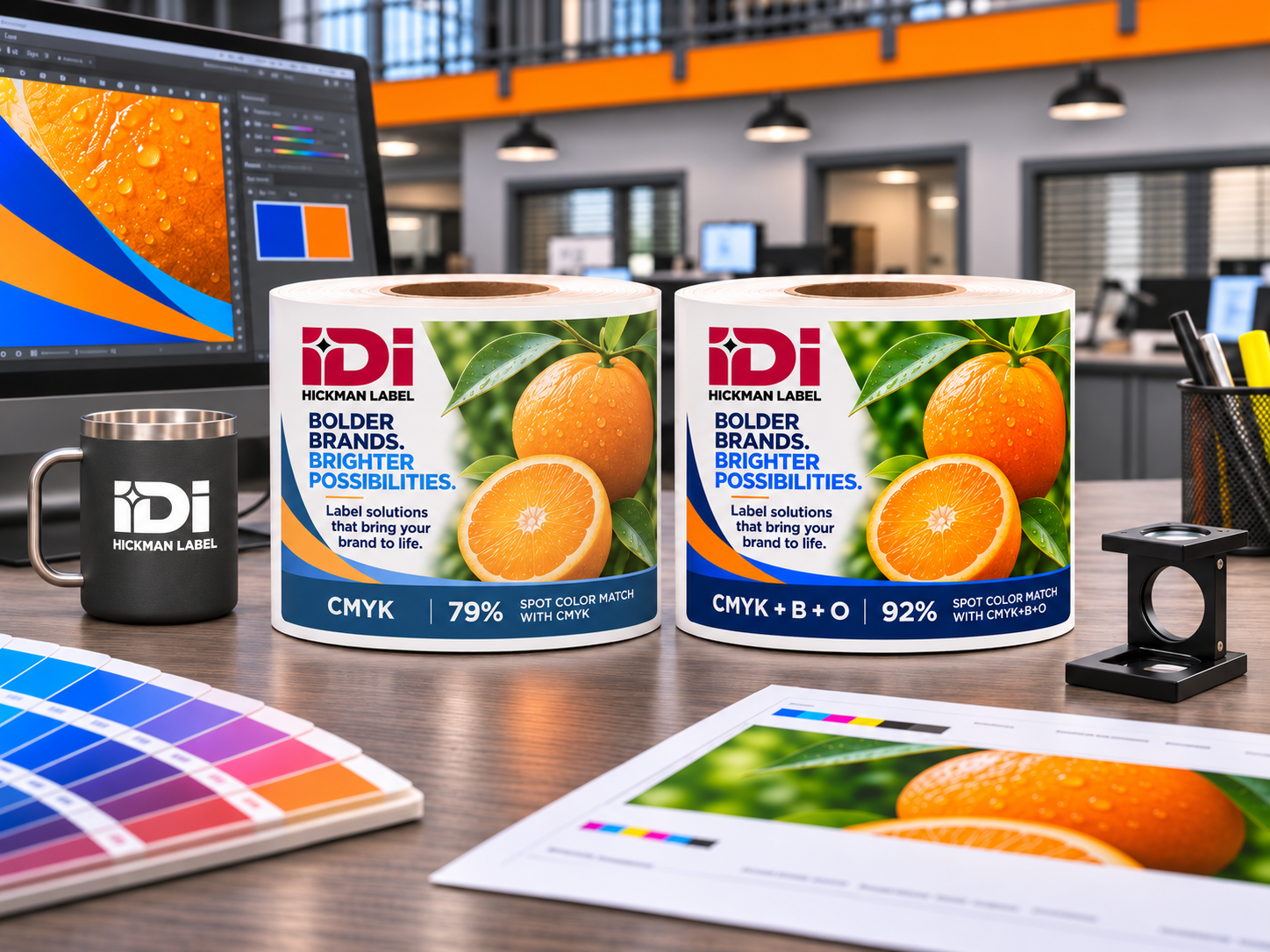
04 Nov Your Complete Guide to Expanded Gamut Printed Labels: How Hickman Now Matches 92% of Spot Colors
Quick answer: At Hickman Label, we now print custom roll labels on a seven-color UV inkjet press right here in Lebanon, Tennessee. Adding Orange and Blue inks to CMYK lets our press match about 92% of standard spot colors within 3.0 Delta E (dE00), up from about 79% with CMYK alone. Order them right here on our website, with a digital proof before anything prints.
If you’ve ever opened a box of labels and thought, “That’s not quite our orange,” you’re not alone. Some brand colors have always been hard to hit with standard four-color digital printing. We added two new inks to change that. Here’s what expanded gamut means for your labels, and how to order them.
Here’s the scoop:
- What’s new: Orange and Blue inks now run alongside cyan, magenta, yellow, black and white, for seven colors in all.
- The result: About 92% of standard spot colors matched within 3.0 Delta E, up from about 79% with CMYK alone.
- Biggest gains: Bright oranges, signature reds, saturated blues, rich purples and clean greens.
- How to order: Online in three steps (shape and size, material, artwork), with a digital proof before printing.
- Where it’s printed: Right here in Lebanon, Tennessee. We’re part of ID Images, a collective of award-winning label companies across North America.
What Is Expanded Gamut Label Printing?
Expanded gamut label printing adds extra ink colors to the standard four (cyan, magenta, yellow and black, or CMYK) so a digital press can reproduce a wider range of colors.
A printer’s “gamut” is simply the full range of colors it can produce. CMYK printing builds every color by layering tiny dots of those four inks. That works beautifully for most artwork, but some colors sit outside what CMYK can mix, especially very bright oranges and deeply saturated blues. Adding dedicated Orange and Blue inks stretches the gamut into those areas, so the press can hit colors it used to only approximate.
Our UV inkjet press now runs seven inks:
- Cyan, magenta, yellow and black for full-color printing
- Orange and Blue to expand the color range
- White as an opaque base, so colors stay bright on clear and metallic materials
CMYK vs. Expanded Gamut: What’s the Difference?
Here’s how standard four-color printing compares with our expanded gamut setup:
| Standard CMYK | Our expanded gamut | |
| Inks used to build color | Cyan, magenta, yellow, black | CMYK plus Orange and Blue |
| Spot colors matched within 3.0 ΔE (dE00) | About 79% | About 92% |
| Bright oranges and warm reds | Built from stacked magenta and yellow | Built with a dedicated orange ink |
| Saturated blues and purples | Built from stacked cyan and magenta | Built with a dedicated blue ink |
| Ink layers on bold colors | Heavier, stacked layers | Thinner layers with cleaner detail |
The match rates come from the press manufacturer’s testing against an industry-standard solid spot color library, measured with the dE00 formula at a 3.0 threshold.
Which Brand Colors Benefit Most?
The colors that improve most are the ones four-color digital printing has always struggled with:
- Bright oranges, like the orange on a hardware store apron
- Signature reds, like the red on a soda can
- Saturated blues, like a tech company’s logo blue
- Rich purples, like a premium chocolate wrapper
- Clean, bright greens, like the green on a coffee shop cup
If your logo or packaging leans on one of these colors, expanded gamut is worth a look. The fastest way to know for sure is to see your own artwork printed on the material you plan to use.
Why Don’t My Printed Labels Match My Brand Colors?
It’s one of the most common questions we hear, and there’s usually more than one reason:
- Screens and printers speak different color languages. Your monitor mixes light (RGB), while printers mix ink, so some on-screen colors can’t be printed exactly. We cover this in On-Screen vs. Printed Colors: Understanding RGB and CMYK.
- Your monitor may not be calibrated. An uncalibrated screen can make colors look brighter or warmer than they’ll print. Here’s how to calibrate your monitor for print artwork.
- The color sits outside the CMYK range. This is exactly the gap expanded gamut closes for many oranges, blues, purples and greens.
- The material changes the look. The same artwork can look different on paper, white film or clear film. Our Label Materials Guide walks through the options.
- You’ve gotten used to an older version. Sometimes a previous printer’s off-shade becomes the color a team expects. Measuring color with Delta E, rather than by eye, takes the guesswork out.
What Does “Within 3.0 Delta E” Mean?
Delta E (ΔE) is the standard measurement printers use to describe how different two colors are. A ΔE of 0 is a perfect match, and the higher the number, the bigger the difference.
When we say the press matches about 92% of spot colors within 3.0 ΔE, we mean that for about 92 of every 100 colors in an industry-standard solid spot color library, the printed result lands within 3.0 of the target using the dE00 formula. That’s a common tolerance for brand color matching, and differences below it are subtle enough that most people won’t notice them on the shelf.
Why Does UV Inkjet Matter for Product Labels?
UV inkjet printing jets tiny droplets of ink onto the label material, then cures them instantly with ultraviolet light. Because there are no printing plates, it fits the way many growing brands order labels:
- Short runs make sense. Order what you need for a launch, a test market or a seasonal product.
- Multiple designs, one order. Print several SKUs or flavors together when they share a size and material.
- Durable results. Paired with the right material and finish, cured UV ink holds up well to moisture, handling and refrigeration. Our guide to waterproof label stocks can help you choose.
- Clear and metallic options. White ink keeps colors bright on clear and metallic materials. Curious about metallic looks? Here’s how to get metallic elements on your labels.
Will My Colors Stay Consistent When I Reorder?
Consistency matters as much as the first match. Our expanded gamut labels are printed on a Screen Truepress LABEL 350UV SAI S, the first UV inkjet label press to earn Idealliance’s Digital Press System Certification for extra-wide color gamut printing (see Screen’s announcement). That certification tests color accuracy, uniformity and repeatability, the qualities that keep a reorder looking like the first run.
We shared more about what that certification means for our customers in Why Hickman Label Customers Love Their Labels: Now Certified to Impress.
How Do I Order Expanded Gamut Labels?
You can order printed labels right here on our website in three steps, plus a proof:
- Choose your shape and size. Pick from squares and rectangles (rounded or square corners), circles and ovals. Need something different? Use our custom printed label inquiry form.
- Select your material. Choose paper, white film or clear film based on where your product lives. Not sure which? Our team can recommend a material and adhesive for your application.
- Upload your artwork. We accept PDF, AI, EPS and high-resolution TIFF or PNG files, and you can add more than one design to the same order.
- Approve your digital proof. We send a proof showing layout, color and orientation, and nothing prints until you approve it.
Tip: If your brand has official color targets, mention them when you order or contact our team, so we know exactly what to aim for.
Want to see your colors in person first? We can print a physical proof for $75, and that $75 is credited back to your first order. Start your printed label order.
Who Should Consider Expanded Gamut Labels?
Expanded gamut is a strong fit for brands whose color is part of their identity, including:
- Specialty food and sauces, where bold, appetizing color sells
- Coffee and tea roasters with a recognizable signature shade
- Bath, body and beauty brands built on bright, consistent palettes
- Craft beverages, from beer and wine to canned cocktails
- Supplements and wellness products with color-coded flavors or SKUs
- Growing brands moving off in-house printers. If you’re weighing that switch, our guide to blank vs. printed roll labels can help.
Frequently Asked Questions
Does Hickman Label offer expanded gamut printing?
Yes. We print custom roll labels on a seven-color UV inkjet press at our Lebanon, Tennessee, facility, using Orange and Blue inks alongside cyan, magenta, yellow, black and white.
What percentage of spot colors can you match?
About 92% of standard spot colors within 3.0 Delta E (dE00), compared with about 79% using CMYK alone.
Can I order expanded gamut labels online?
Yes. Choose your shape, size and material, upload your artwork and approve a digital proof on our Order Printed Labels page.
What’s the difference between spot colors and process colors?
Process colors are built on press by combining a set of base inks: CMYK, plus Orange and Blue on an expanded gamut press. Spot colors are specific, named brand colors from a standard color library, traditionally printed with a custom-mixed ink. A digital press builds spot colors from its process inks, and expanded gamut lets it build far more of them accurately.
Can expanded gamut match every color?
No printing process matches every color. Expanded gamut reaches about 92% of standard spot colors, but true metallics and fluorescent colors can’t be reproduced with process inks. For metallic looks, see how to get metallic elements on your labels.
Can I see a printed sample before I order?
Yes. Every order includes a digital proof. For $75, we can print a physical proof or samples, and that $75 is credited toward your order.
What file formats do you accept?
PDF, AI, EPS and high-resolution TIFF or PNG. Files should be press-ready with fonts outlined or embedded, and our team can review your file before printing.
Where are your labels printed?
Right here in Lebanon, Tennessee. Hickman Label is part of ID Images, a collective of award-winning label companies across North America.
Ready to See Your Brand Colors Come Through?
Whether you’re launching your first product or you’re tired of labels that are almost right, expanded gamut gives your brand colors more room to shine. Start your printed label order, or if you have questions about your colors, materials or artwork, let’s chat!
We’re proud to be part of ID Images. For the group-wide announcement, see Bolder Brand Colors, Tougher Labels.