

04 May Why Do Label Orders Have Minimum Quantities? (And Why It Saves You Time and Money)
If you’ve ever gone to order labels and run into a minimum order quantity (MOQ) that’s more than what you were planning to order, your first thought was like something along the lines of:
“Why can’t I just order the number I actually need?”
Fair question.
Minimum order quantities can feel like an unnecessary hurdle—but in label production, they exist for a very practical reason: efficiency, quality, and long-term cost control.
At Hickman, minimums aren’t about making small orders difficult. They’re about making sure your labels are produced correctly, priced fairly, and matched to the real demands of your printer or application.
In short:
- MOQ is not a random rule.
- It’s how we help customers avoid the most expensive way to buy labels.
Let’s break it down.
What Is an MOQ?
MOQ stands for Minimum Order Quantity.
It’s the smallest quantity of labels that can be produced efficiently while maintaining quality and reasonable pricing.
Whether you’re ordering:
- custom printed labels
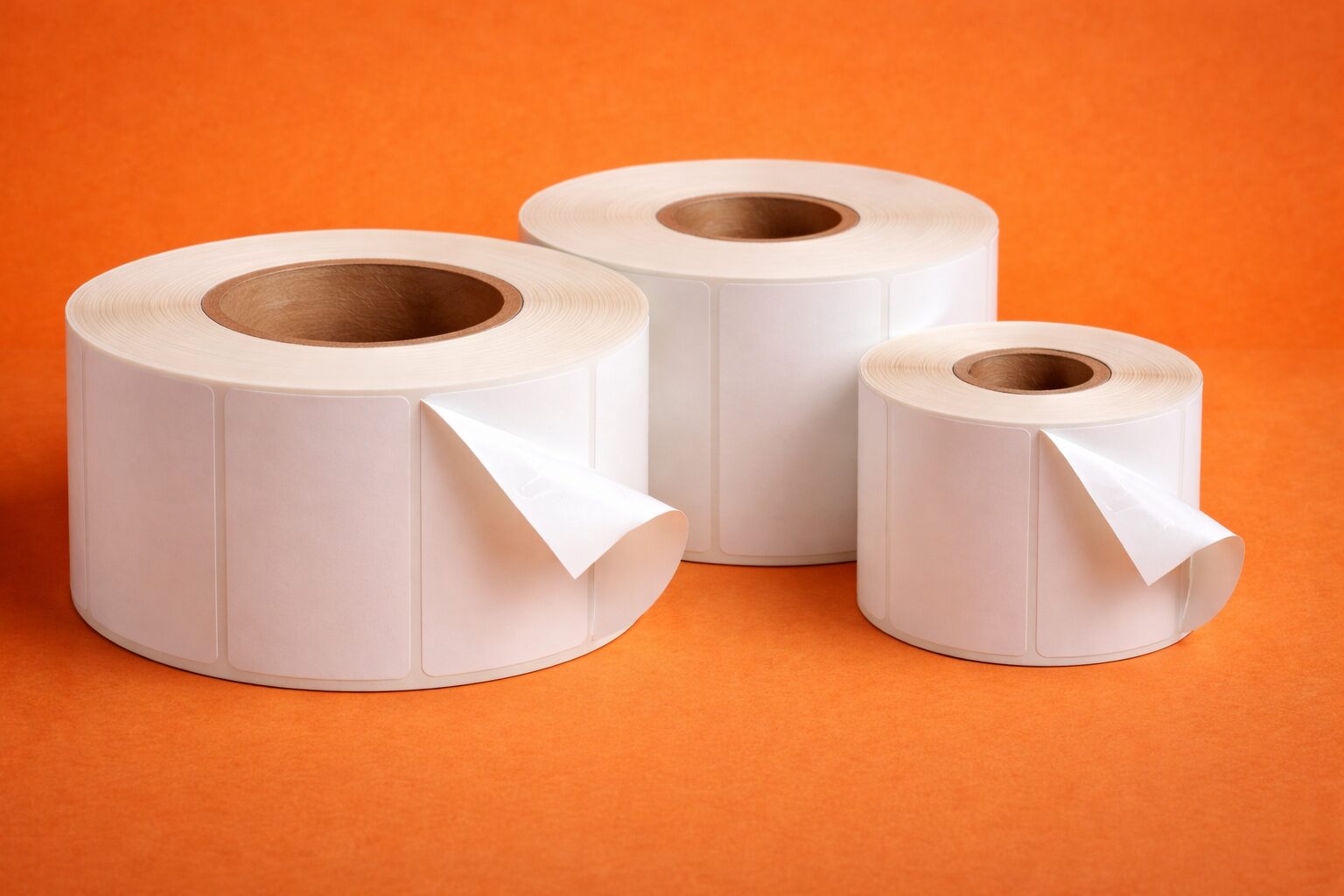
- blank roll labels for in-house printing
- specialty labels with timing marks
- custom die-cut labels requiring new tooling
…the production process includes setup work that happens before the first label is ever made.
That includes things like:
- press setup
- material preparation
- printer configuration
- die setup or flex tool creation
- registration alignment
- quality control checks
Whether you order 250 labels or 25,000, much of that work stays the same.
That’s why very small orders often end up being the least cost-effective.
Hickman’s Typical Minimum Order Quantities
For most standard orders, Hickman works around these practical minimums:
Printed Labels
250 printed labels per size/material combination
Multiple versions or designs can often be combined within that same size and material setup, depending on the project.
This is common for:
- multi-SKU packaging
- product variations
- seasonal label versions
- multiple scents, flavours, or product lines
That flexibility helps customers stay efficient without forcing unnecessary over-ordering.
Hickman’s printed label system is built around custom roll labels with multiple material and size options.
Blank Roll Labels
Minimum: 1 roll
This applies to most standard blank roll label orders.
Because blank labels are typically ordered for in-house printing, flexibility matters more than large-volume commitments.
However, there are a few important exceptions.
Hickman’s blank roll label builder supports a wide range of custom roll configurations and printer-specific setups.
When the Minimum Increases
Some orders require additional setup, which changes the minimum.
Orders Requiring Timing Marks
Minimum: 3 rolls
Timing marks (also called registration marks) help certain printers properly detect label position during printing.
If your printer requires black timing marks, Hickman’s minimum quantity is 3 rolls.
This is already noted directly in the roll label builder because setup requirements are higher.
Orders Requiring a New Flex Tool
Minimum: 3 rolls
If your order requires a brand-new custom flex tool for a unique shape or size, additional production setup is required.
That upfront tooling cost needs enough volume to make the order practical and cost-effective.
This is especially common with:
- custom die-cut shapes
- unique label dimensions
- specialty applications
Basically:
custom shapes are cool, but physics still sends invoices.
Why Small Orders Often Cost More
This surprises people:
Ordering less does not always mean spending less.
For example:
Ordering:
1,000 labels once
is often more cost-effective than ordering:
250 labels four separate times
Why?
Because setup costs repeat every time.
Small repeat orders create:
- more setup labour
- more downtime
- more production interruptions
- higher per-label pricing
Very small runs are often the most expensive way to buy labels.
And no one enjoys paying premium pricing for inconvenience.
Understanding Over / Under Quantities For Specialty, Non-Stocked Materials
Another important part of ordering custom labels is understanding over / under quantity tolerance—if you’re ordering speciality material that we don’t regularly keep in stock.
In label production, exact quantities are not always guaranteed down to the final individual label.
During manufacturing, factors like:
- press setup
- material waste
- quality control inspections
- finishing and slitting
- damaged or rejected labels during production
can affect the final usable quantity.
Because of this, many label manufacturers work within an over / under tolerance, often up to 10% depending on the order.
That means if you order 1,000 labels, the final shipped quantity may be slightly lower—or occasionally slightly higher—based on normal production realities.
At Hickman, the goal is always to deliver accurate, production-ready orders, but exact piece-for-piece counts are not always realistic in custom label manufacturing when your label material is a non-stocked item.
This is not an error.
It’s part of how real label production works.
Why Ordering Extra Can Save You Money
One of the most common issues happens when customers order exactly the number of labels they think they need.
Then:
- production runs slightly larger than expected
- a few labels are lost during application
- the final shipped quantity lands slightly short due to normal QC tolerance
Suddenly, the customer only needs:
“just a few more labels”
That small reorder often becomes surprisingly expensive.
Why?
Because it can trigger:
- minimum order quantities
- new setup time
- additional production costs
- shipping delays
- downtime waiting for replacements
Ordering 100 extra labels upfront is often far less expensive than placing a second order for “just a few more.”
Especially when that second order still has to meet MOQ requirements.
No one enjoys paying minimum-order pricing for a problem that could have been prevented.
A Better Rule of Thumb
When planning your label order:
Order for real production conditions—not perfect math.
That means considering:
- over / under tolerance
- setup waste
- production variation
- future short runs
- emergency replacement needs
The goal is not over-ordering.
It’s avoiding expensive reorders caused by preventable shortages.
A little extra inventory is usually much cheaper than a last-minute rush order.
Especially when your production line is waiting on labels.
And production lines are famously bad at being patient.
What About Shelf Life?
Ordering more only helps if the labels stay usable.
Most label materials perform best when used within:
approximately 6 months
when stored properly.
Best storage conditions include:
- clean, dry environment
- stable room temperature
- protection from moisture and excess heat
- avoiding prolonged sunlight exposure
The goal is not:
“order as much as possible”
It’s:
order the smart amount.
Enough to improve efficiency without creating waste later.
That balance matters.
The Better Question Isn’t “What’s the Minimum?”
It’s:
“What’s the smartest order size for my business?”
That depends on:
- monthly usage
- number of SKUs
- reorder frequency
- storage conditions
- printer compatibility
- whether labels change often
- whether you print in-house or order pre-printed
MOQ is just the starting point.
Efficiency is the real conversation.
Can Small Businesses Still Order?
Absolutely.
MOQ does not mean:
“you need to be a massive manufacturer.”
It means we want your labels produced in the most practical and cost-effective way possible.
Sometimes that means:
- consolidating SKUs
- adjusting materials
- simplifying shapes
- moving from printed labels to blank roll labels
Sometimes it means:
- combining versions within one setup
The goal is not forcing a larger order.
The goal is helping you order smarter.
Not Sure What Quantity Makes Sense?
Get in touch here and tell us:
- what product you’re labeling
- whether you need printed or blank labels
- how often you reorder
- whether your printer requires timing marks
- whether your design changes frequently
Hickman’s team can help recommend the most efficient order size—not just the smallest possible one.
Because the cheapest order on paper is not always the cheapest order in practice.
And label waste, like most expensive mistakes, tends to start with trying to do it cheap instead of smart.
Updated May 2026.